
From Persian Dynasties to London Museums: The Five-Century Journey of the Ardabil Carpet
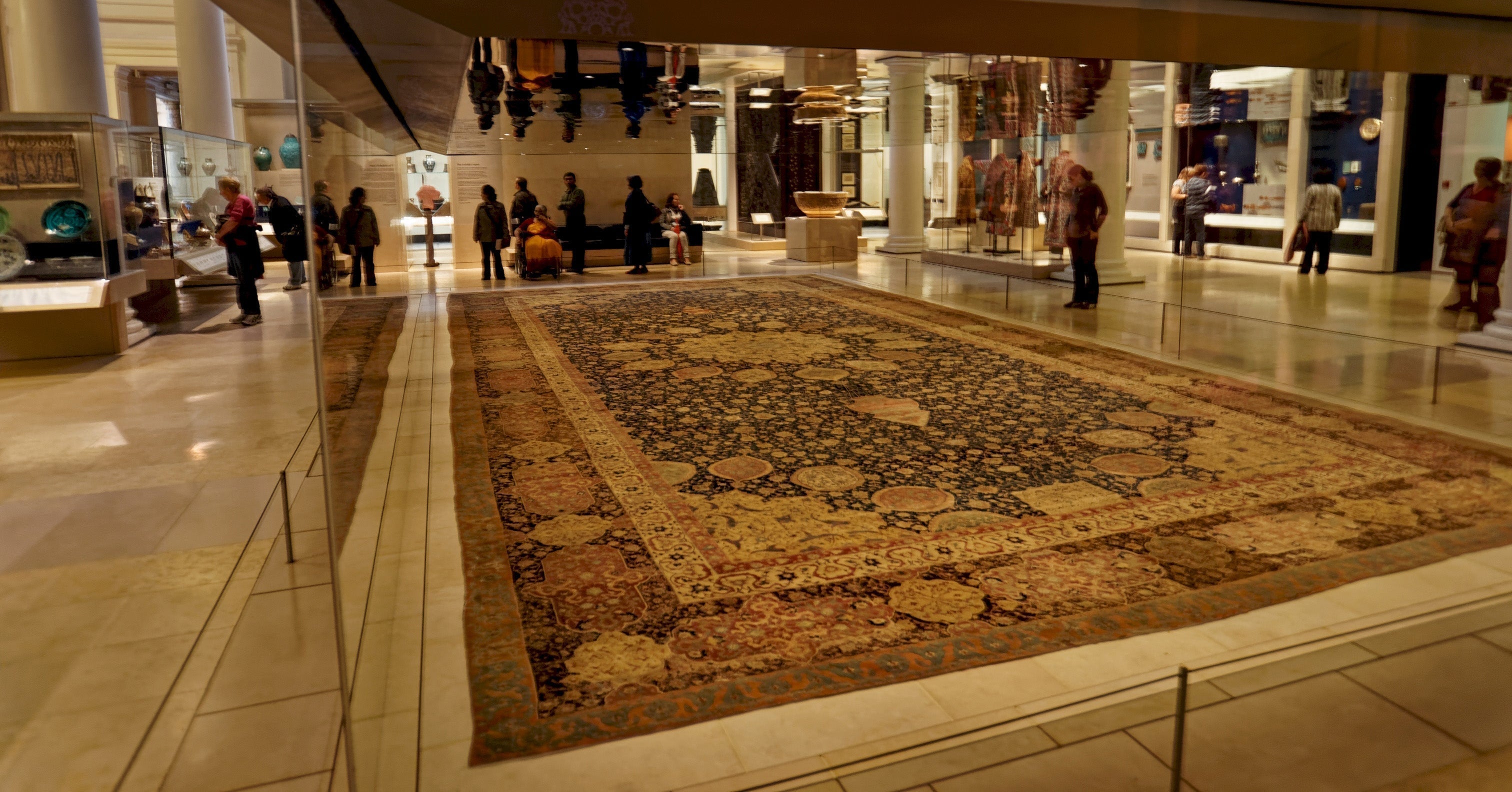
The museum even redesigned the exhibition space for one carpet. The Ardabil Carpet is enormous and nearly five centuries old. When the V&A re-exhibited it, they carefully used multiple pulleys and support equipment to unload the entire carpet. In 2006, a dedicated horizontal display case was built for it. Low-iron anti-reflective glass, shading structures, and controlled lighting are all designed to reduce long-term light damage to natural dyes. Today, the carpet is only briefly illuminated for about ten minutes at the top and bottom of each hour. For the museum, it is no longer a movable interior decoration but a textile artifact that must be protected with engineering, science, and time.
The Ardabil Carpet at the Victoria and Albert Museum, London. Photo: Txllxt TxllxT / Wikimedia Commons, CC BY-SA 4.0. Cropped from the original.
Among the vast collections of the Victoria and Albert Museum (V&A) in London, there is one piece that, even surrounded by countless treasures, is enough to make anyone pause—the Ardabil Carpet. Measuring approximately 10.4 meters long and over 5.3 meters wide, with a surface area of nearly 56 square meters, it is hardly what we typically consider a "carpet." Instead, it resembles a magnificent architectural decoration crafted from wool and silk. A deep indigo blue covers the entire surface, with a massive golden star-shaped Medallion at its center. Countless flowers, leaves, and vines extend outwards from the center, maintaining an incredible order and balance across its more than ten-meter span. Completed between 1539 and 1540 CE, this piece is now considered one of the most important Persian carpets in the world.

Its history is equally dramatic. The Ardabil Carpet was originally in a Safavid-era royal building in Ardabil, northwestern Iran, and was one of a pair of nearly identical massive carpets. By the 19th century, both carpets had suffered varying degrees of damage. The more poorly preserved one even became a source of material for repairing the other, leaving a trace of the modern history of antique trading and restoration in the two pieces now held in London and the United States. What is truly astonishing is that the carpet still retains its weaving date and signature, allowing later generations the rare opportunity to know the precise birth date of a 16th-century Persian carpet. Because of this historical benchmark, it has long transcended the role of a lavish decoration and become important physical evidence for studying Safavid art.
When the carpet appeared on the London market in 1893, the V&A did not hastily decide whether to acquire it. Instead, they invited William Morris, a key figure in the British Arts and Crafts movement, to personally inspect it. Morris, an expert in carpets, textiles, and decorative arts, gave the piece a very high appraisal. The museum finally purchased the Ardabil Carpet for £2,000 in March of the same year—a very substantial acquisition cost in the Victorian era. For over a century since, it has not only become a masterpiece of the V&A's Islamic art collection but also the subject of extensive research, preservation, and exhibition efforts by the museum. What visitors see today is not an old carpet casually laid on the floor, but a work meticulously preserved as an important artifact of textile art history.
Perhaps the most intriguing aspect of the Ardabil Carpet is not its monetary value, but rather the visual language established five hundred years ago that still holds power today. Its deep blue field, massive central medallion, regularly expanding floral vines, and layer upon layer of framed borders later became one of the most representative compositions of classical Persian carpets. Even in today's large homes, private clubs, or collector's spaces, this type of dark, large carpet still possesses a gravitas that other interior decorations cannot replace: it doesn't just fill the floor but acts as a visual anchor, reorganizing furniture, architecture, and the entire space.
It is precisely for this reason that Flanders Rug currently has acquired, through collecting channels, agenuine hand-knotted Persian wool carpet from Tabriz, Iran, measuring 253x364cm↗. It is not an intentional replication or correspondence to the Ardabil Carpet in the V&A's collection, but rather a contemporary echo that continues its compositional logic within the same classical Persian textile vocabulary: a deep ink-blue main color, a large central Medallion, intricate floral vines, and layered borders, presenting a very mature and complete traditional appearance across its approximately nine-square-meter surface. This design language is precisely what captivated design authorities like William Morris when they encountered the Ardabil Carpet—the visual tension created by order, proportion, and decorative density. For those who truly love classical Persian carpets, the appeal has never been merely the craftsmanship specifications, but rather the composition and grandeur that have endured for centuries and remain relevant in interior aesthetics. While museums collect historical originals, what we can collect today is the art of Persian hand-knotting, which continues to be woven within the same aesthetic脈絡.