
When the King Decided to Make His Own Carpets ~ Savonnerie and Louis XIV's Luxurious Ambition
In 17th-century Europe, the most expensive luxury item was certainly not a car, nor jewelry or a famous watch, but a handmade carpet from the East.
European aristocrats at the time flocked to Turkish and Persian carpets, and vast amounts of gold and silver continuously flowed into the Ottoman Empire and Persia. The French kings observed this, but had another idea in mind:
Why couldn't France produce the world's best carpets itself?
Thus began a carpet story that would last for centuries.
The name Savonnerie actually comes from the French word for "soap factory." In the early 17th century, an abandoned soap factory in the suburbs of Paris was converted into a carpet workshop. King Louis XIII granted manufacturing privileges, and artisans returning from the East introduced Turkish knotting techniques. France's first royal carpet workshop was thus born.
 Portrait of Louis XIV / Collection of the Louvre Museum, Paris, France. Image: Wikimedia Commons, Public Domain. Hyacinthe Rigaud, Portrait of Louis XIV in Coronation Robes, 1701, Louvre Museum.
What truly made Savonnerie famous was the later "Sun King," Louis XIV.
Louis XIV was not satisfied with merely owning a palace. He wanted France to become the center of European culture and art, and everything from furniture, tapestries, porcelain, to carpets had to be produced by France itself, and be the best in all of Europe. So, Finance Minister Colbert began establishing a series of royal workshops, and the Savonnerie carpet workshop was one of the most brilliant jewels among them.
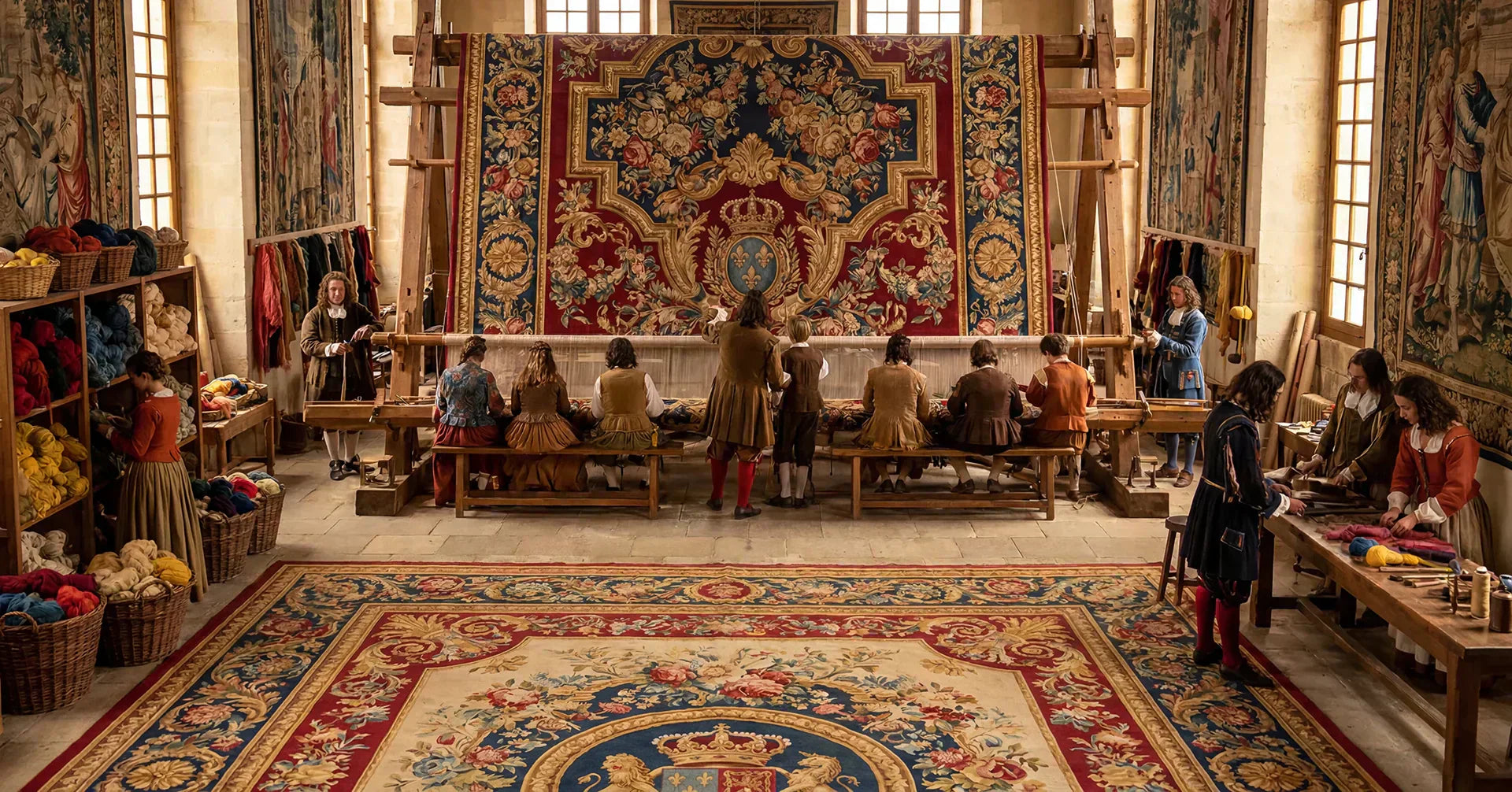
 Schematic diagram of a royal carpet workshop during the time of Louis XIV
In 1668, Louis XIV issued an almost insane command.
He ordered Savonnerie to produce a complete set of carpets for the Grand Gallery of the Louvre.
Not just one.
But over ninety carpets.
Not a few tens of square meters.
But nearly four thousand square meters.
This project took twenty years to complete, employed countless artisans, and is considered by later generations to be one of the most ambitious projects in the history of European carpets.
 Savonnerie carpet in a French palace interior. Image: The Metropolitan Museum of Art, Public Domain / Open Access. Grande Galerie carpet no. 73 (Landscapes), Savonnerie Manufactory, 1680.
Interestingly, these carpets were ultimately not laid in their originally planned locations.
Because Louis XIV had turned his attention to the Palace of Versailles.
By the time all the carpets were woven, the King had already moved out of the Louvre. These masterpieces, representing the pinnacle of French craftsmanship, were collected, moved, given as gifts, and even cut up and sold during the French Revolution. Centuries later, only some original pieces remain fully preserved.
 Savonnerie carpet in a French palace interior. Image: The Metropolitan Museum of Art, Public Domain / Open Access. Grande Galerie carpet no. 73 (Landscapes), Savonnerie Manufactory, 1680.
Louis XIV transformed craftsmanship into national power, thereby propelling modern France to become an empire of luxury goods.
The most fascinating aspect of the Savonnerie story is not just the carpets themselves, but how it shows us a nation combining craftsmanship, art, and power.
Louis XIV might not have imagined that centuries later, France would still be renowned worldwide for its fashion, perfumes, jewelry, leather goods, and fine craftsmanship. From the Palace of Versailles to the luxury boulevards of Paris, the French have long transformed "beauty" into a national language.
From royal carpet workshops and the Palace of Versailles to France's later global renown in fashion, perfumes, jewelry, and leather goods, there is a consistent underlying theme—the close integration of technology, aesthetics, and national image. Savonnerie was not just a luxurious textile laid in royal palaces; it also witnessed how France elevated top-tier craftsmanship to a symbol of culture and national strength, laying a profound foundation for its future as a global hub for luxury brands.