
How to choose carpet size? Don't just look at the sofa width, but understand the entire space.
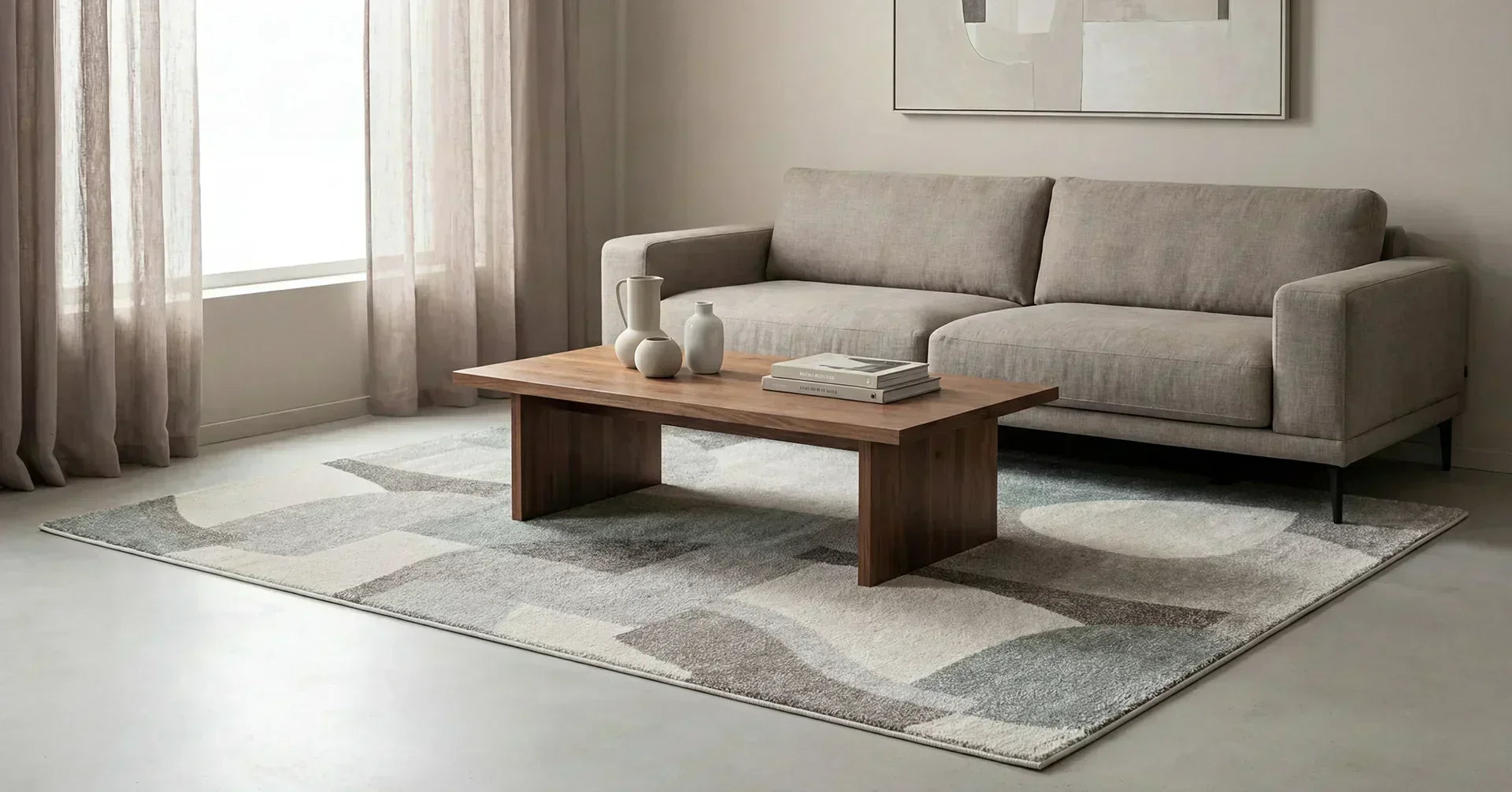
When choosing a living room rug, the first advice many people hear is often: "The rug should be wider than the sofa," "The front legs of the sofa should be on the rug," and "Leave space around the coffee table."
There's nothing wrong with this advice.
However, if you only follow these formulas to select a rug, you often encounter a problem: the size might seem correct, but it may not be practical in use, visually harmonious, or align with your desired lifestyle.
This is because a rug doesn't just interact with the sofa; it's also influenced by the room size, the number of furniture pieces, distance to walls, the owner's habits, and more.
The truly suitable rug size should be determined by "how the owner intends to use this space."
Common Size Rules: They can be referenced, but don't memorize them rigidly
Generally, there are several common principles for living room rugs:
- The rug's width should ideally be slightly wider than the sofa for visual stability.
- Having the front legs of the sofa on the rug helps to create a complete living room area with the sofa, coffee table, and armchairs.
- Leaving adequate space around the coffee table makes it less cramped to use.
These are all excellent basic concepts. They are indeed very practical, especially in square living rooms with standard sofas and coffee tables.
However, living rooms in reality are often not so standard.
Some living rooms are long, some are narrow; some sofas are against a wall, some are in an open-plan layout; some families use the living room as the main activity area, while others just need a visual focal point.
Therefore, size rules can only serve as a starting point, not the sole answer.
Consider the relationship between the entire sofa set and accessories, not just the main sofa
Many people only measure the sofa width when choosing a rug, but in practice, it's more important to look at the entire furniture set.
A living room usually doesn't have just one sofa; it's composed of a sofa, coffee table, side table, armchair, TV wall, and walkway.
Therefore, while sofa width is an important reference when choosing a rug, it shouldn't be the only basis. A suitable rug isn't just placed in front of the sofa; it should connect the rug itself with the sofa, coffee table, armchair, and surrounding circulation paths to create good functionality for daily life.
A better way to determine is:
Should this rug "frame" the entire living room seating area?
If the answer is yes, then the size usually needs to be larger, so that at least the front legs of the sofa, coffee table, and armchairs can all interact with the rug. This approach makes the space feel more complete and has a better design aesthetic.
If limited by living room space or other functional considerations, and you only want the rug in front of the sofa/under the coffee table to add a warm and cozy visual effect and soften lines, then the size can be smaller. However, avoid making it so small that it looks like an isolated mat, merely serving as a coaster for the coffee table, creating a top-heavy impression.
The same sofa, different arrangements, might require completely different rug sizes
Even with the same three-seater sofa, placed in different living rooms, the suitable rug size might vary.
If the sofa is against a wall/boundary, directly facing a TV wall, with not much furniture nearby, the rug can be chosen based on the sofa width and coffee table area.
 If the sofa is against a wall/boundary, directly facing a wall, with not much furniture nearby, the rug can be chosen based solely on the sofa width.
However, if there are also armchairs, chaise lounges, or even an L-shaped sofa nearby, the rug should not just align with the main sofa, but rather define the entire seating area.
 If the sofa area has many accessories, it is recommended to consider all subordinate items.
If it's an open-plan living and dining room, the rug has another function: defining the living room area. In this case, if the size is too small, the living room will appear to float and be insignificant within the larger space.
 For an open-plan living/dining room, do not choose a rug that is too small for the main sofa area.
So before choosing a rug, it's best to first look at the furniture arrangement, rather than just asking: "My sofa is 270 cm, how big should I buy?"
A more accurate question should be:
Which furniture set do I want this rug to encompass? And which pathway do I want to keep clear?
Should a walkway be left from the living room to the balcony, or in front of the TV wall?
This is a very practical question, but rarely explicitly addressed.
Many Taiwanese homes have living rooms that connect to a balcony, or lead to a window, French doors, or a laundry area. In these cases, the rug size isn't just about aesthetics; it also relates to daily circulation.
Some people don't like stepping on a rug every time they go to the balcony, especially concerning outdoor dust, moisture, or cleaning burdens. Such households are better off with a rug that stays within the main seating area, not necessarily covering the entire area between the sofa and the balcony.
 Whether to leave a walkway between the living room and balcony is a matter of daily functionality, not right or wrong.
But others don't mind stepping on a rug, and even wish for a more complete, warmer underfoot feeling in the living room. In this case, a larger rug can be chosen to better integrate the sofa area, coffee table area, and the activity space in front.
Neither choice is absolutely right or wrong.
What truly matters is that the rug size should fit your home's functional needs, not the pretty compositions in magazine photos.
Avoid judging solely by "bigger is better" or "just fits"
A large rug can indeed make a space feel more complete, especially in spacious living rooms, open-plan layouts, or when furniture is more spread out, the effect is usually very good. However, if major circulation paths are covered by the rug, or if the living room depth is already limited, an excessively large size might make daily use cumbersome.
Conversely, a rug that is too small can easily lose its function of organizing the space. If the rug only sits under the coffee table, with little connection to the sofa, armchair, or surrounding furniture, it tends to look fragmented visually.
A better way to determine this is not to ask "Is bigger better, or smaller better?", but to see if the rug can create a natural connection between the existing furniture and circulation paths.
Standard sizes of imported rugs can already cover most home spaces
For the Belgian imported rugs Flanders Carpets has represented for years, common sizes are mostly concentrated in the following groups:
- 160 x 230 cm / 170 x 230 cm
- 200 x 290 cm / 200 x 300 cm
- 240 x 330 cm / 240 x 340 cm
- 280 x 380 cm / 300 x 390 cm
These sizes are not arbitrarily set; rather, they are mature specifications developed by manufacturers based on long-term feedback from global markets, considering most home spaces, sofa proportions, and living/dining room layouts. From small living rooms and standard three-seater sofas to more spacious open-plan living/dining rooms, suitable options can usually be found within these sizes.
If the space conditions are rather special, such as an extremely long and narrow living room, or if one desires the rug's length and width to more closely match the on-site layout/personal needs, Flanders Carpets also offers in-house rug modification services. Dimensions can be altered according to the owner's request, allowing standard imported rugs to achieve an effect close to custom-made rugs.
For dining room rugs, consider the space when chairs are pulled out
The logic for determining dining table rug sizes differs from living room rugs.
While living rooms can discuss visual proportions, dining rooms prioritize functionality.
The most common problem is: the rug size is only slightly larger than the dining table, appearing just right, but when a chair is pulled out, its back legs fall off the rug. This not only makes it uncomfortable to sit but also causes the chair to snag on the rug's edge when being pushed or pulled.
 Therefore, for dining room rugs, don't just measure the tabletop; also include the usage area when chairs are pulled out.
If the dining room space is insufficient, instead of struggling with a rug that is too small, it's better to first consider whether a dining room rug is truly necessary. Because once a dining room rug is undersized, the inconvenience in daily use will be more noticeable than in the living room.
Bedroom rug focus is not display, but the feel underfoot when getting out of bed
Living room rugs often play a visual protagonist, but bedroom rugs are more about comfort.
The ideal state is to have your feet naturally land on a soft rug when you get out of bed in the morning, rather than a cold floor.
 If space allows, the rug can extend from under the bed to both sides and the foot of the bed, creating a complete wrap-around effect.
If space is limited, you can also choose to place a small rug on each side of the bed, or only on the main side where you get out of bed. This isn't necessarily worse than a large rug; it might even be more suitable for certain room types.
Bedroom rugs don't need to relentlessly pursue the largest size; the key is to place them where they will truly be stepped on and felt.
Before visiting the store, photos are more helpful than just providing dimensions
If you already have an interior designer, it would be ideal to invite them to come to the store with you when choosing a rug.
Designers are professionally trained and are most familiar with the furniture proportions, color schemes, circulation arrangements, and overall style of the site. During on-site communication, they can quickly determine whether the rug should play a leading role, a supporting role, or simply add a layer of warmth to the space.
If you are coming to choose a rug yourself, it is also recommended to take several photos of the area in your home where the rug is intended to be laid. Photos often provide a better understanding of the space than just providing length and width dimensions.
When taking photos, try to include both wide-angle/long shots and close-ups. Wide-angle/long shots can show the relationship between the living room, dining room, walkway, and TV wall; close-ups can clearly show the colors and materials of the sofa, coffee table, dining table, armchairs, curtains, flooring, walls, and decorations.
If the living room and dining room are in the same open area, it is also advisable to take at least one or two photos that capture both areas simultaneously. This is because rug size and pattern do not only affect a single corner, but also the overall coherence of the space.
Dimensions are basic information, but photos can better illustrate the relative relationship between spaces and objects. Providing both allows for discussions that are closer to the actual situation, and makes it easier to find the perfect size that matches the owner's habits and space proportions.
Conclusion: The right rug size isn't found through a formula, but chosen through living
When choosing a rug size, there's no one-size-fits-all perfect formula.
The real key is to understand how you want your home to be used, how spatial functions should be expressed, and how to achieve balance between furniture, circulation, and the feeling of home.
When these conditions are clarified, a suitable rug can naturally bring order, comfort, and beauty to your home.